
When ordering custom flexible pouches, many brands face a common challenge: determining the right order quantity for their packaging needs.
MOQ(Minimum Order Quantity) plays an important role in flexible packaging because it influences production economics, inventory investment and overall project risk. Fortunately, digital printing enables greater flexibility for custom pouch orders. It reduces setup requirements and makes smaller production runs more practical for brands that need customized flexible packaging.
What Is MOQ for Custom Flexible Pouches?
Definition of MOQ
MOQ = Minimum Order Quantity
The minimum number of units a packaging supplier can produce in one production run.
How MOQ Works in Flexible Packaging
Custom flexible packaging MOQ is often calculated based per design, per SKU, per pouch specification rather than total order quantity.
If a snack brand has five products with different flavors, such as strawberry, chocolate, vanilla, matcha and coffee. The MOQ may be calculated as 2,000 pouches per design × 5 designs rather than 10,000 pouches shared across all designs.
Why MOQ Matters for Brands
Understanding the impacts of minimum order quantity is essential for brand planning. MOQ plays a vital role across whole packaging project, shaping upfront investment, inventory management and the flexibility of product launches.
Why Do Custom Flexible Pouches Have Minimum Order Quantities?
Any packaging production process involves fundamental preparatory work: equipment commissioning, color calibration, and substrate material preparation, create additional setup and time-related costs.
Production Setup Requirements
Traditional printing needs extra printing plates and cylinders, involving substantial upfront investment. In contrast, without plates, digital printing reduces traditional tooling requirements and supports smaller production runs.
Material Waste and Production Efficiency
During flexible packaging production, material waste inevitably occurs during machine setup, printing adjustment and pouch conversion.
If the order volume is too small, a limited number of packaging pouches may not be sufficient to cover machine startup losses, making it difficult for the factory to accept such orders. However, the low entry barrier of digital printing helps spread fixed production costs.
Manufacturing Economics
MOQ is not designed to restrict brands. Instead, it helps manufacturers maintain production efficiency, control unit costs and ensure consistent quality.
How Digital Printing Helps Reduce Packaging MOQ
Digital printing does not eliminate MOQ, but it allows suppliers to offer lower MOQs by reducing traditional printing setup costs.
No Traditional Printing Plates or Cylinders
This is the core reason behind the low MOQ! Digital printing starts production directly from digital artwork files without requiring gravure cylinders or printing plates, which effectively reduces tooling cost and preparation time, making it suitable for small-batch and short-run production.
Better for Short and Medium Production Runs
The reduced MOQ makes digital printing an ideal choice for short and medium production runs. It serves startups rolling out their first product line, brands launching new items, seasonal goods, as well as limited-edition packaging campaigns.
Easier Multi-SKU Packaging Production
Digital printing brings greater flexibility for multi-SKU projects and cuts MOQ pressure for brands. Since artwork requires no extra printing plates, different designs for various flavours, trial products or limited editions can be manufactured in a single production run. Brands no longer need to place large separate orders for every individual design, making low-volume testing of multiple product variations achievable.
Digital Printing MOQ vs Traditional Printing MOQ
|
Factor |
Digital Printing |
Rotogravure Printing |
|
Printing plates |
Not required |
Required |
|
Setup cost |
Lower |
Higher |
|
Suitable volume |
Short-medium runs |
Large runs |
|
Design changes |
Flexible |
More costly |
|
Best for |
Product testing & new launches |
High-volume products |
Digital printing is usually more economical for smaller quantities.
What Factors Affect Digital Printed Pouch MOQ?
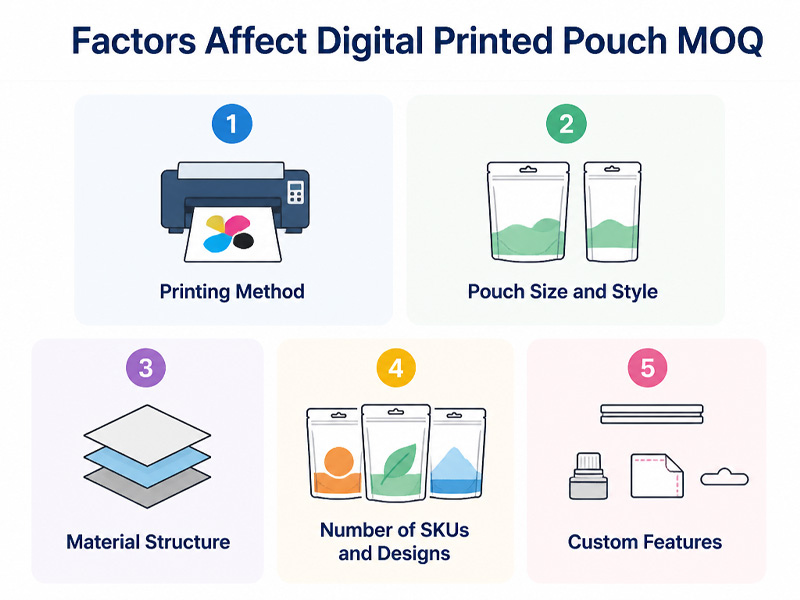
There is no accurate MOQ figure, but we can explore what factors influence the MOQ for digital printing packaging.
1. Printing Method
Printing technology largely determines MOQ. Traditional printing methods use expensive cylinders, which often result in higher MOQs. Meanwhile, digital printing removes plate-making expenses, supporting far smaller production runs. The exact MOQ is not only based on printing method but other factors.
2. Pouch Size and Style
Structural complexity affects production. Standard pouch formats such as stand-up pouches generally require simpler production setups and lower minimum orders. In contrast, spout pouches and custom shaped pouches demand extra adjustments which usually require higher MOQ.
3. Material Structure
Material structure is closely linked to MOQ, influenced by film availability, lamination requirements and barrier performance. For example, common material structures like PET/PE may be easier to source, while specialized structures like PET/AL/PE and mono-PE may require additional material preparation. When raw materials have a minimum procurement threshold, the overall packaging pouch MOQ will be correspondingly increased.
4. Number of SKUs and Designs
Every SKU needs separate artwork and production planning which influence MOQ. Digital printing can change artwork to print without cylinders makes it one of the biggest advantages in dynamic order scenarios. Orders with numerous distinct SKUs involve heavier workflow management, which may lead to a higher MOQ compared to single-design runs.
5. Custom Features
Additional custom functional features affect achievable MOQ. Pouches kept in a basic form have the lowest minimum order threshold. Extra elements including zippers, one-way valves, windows and special finishes require extra machine setup and manual work.
Due to greater production complexity, suppliers generally set a higher MOQ for pouches with multiple custom upgrades.
What Is a Typical MOQ for Digital Printed Pouches?
There is no universal fixed MOQ for custom digital printed pouches. MOQs fluctuate based on supplier capacity, pouch specifications, film materials and specific order requirements.
Although MOQ figures are not standardized across the industry, digital printing’s low-volume advantages fit well into three typical business scenarios:
|
Suitable Scenarios |
Details |
|
Market Testing & New Releases |
New Product Launch, small quantity market testing |
|
Short-Run & Limited Campaigns |
Seasonal Products, limited edition packaging |
|
Agile Brand Inventory Management |
Growing brands, flexible inventory planning |
MOQ vs Unit Cost: Understanding the Trade-Off
Lower MOQ does not mean lower unit cost. Understanding the relationship between MOQ and unit cost is essential for packaging decisions. The table summarizes pros and cons for low-MOQ and high-MOQ packaging orders.
|
Order Quantity |
Advantage |
Challenge |
|
Lower MOQ |
Less inventory risk, More flexible |
Higher unit cost |
|
Higher MOQ |
Lower unit cost, Better cost efficiency |
More inventory investment |
The best MOQ is not always the lowest quantity, but the quantity that matches your business stage.
How to Choose the Right MOQ for Your Packaging Project?
Selecting the right MOQ helps brands balance inventory risks and packaging costs. Refer to the guidance below for your packaging plan:
Choose a Lower MOQ When:
✓ New product launch
✓ Market testing
✓ Seasonal products
✓ Multiple designs
Choose a Higher MOQ When:
✓ Stable demand
✓ Existing best sellers
✓ Need lower unit cost
Matching suitable MOQ for your products allows brands to balance packaging expenses and inventory risks for sustainable product development.
How Brands Can Achieve More Flexible Packaging Orders
Digital packaging has lowered the MOQ threshold; for brand owners, reducing MOQ requirements is key to cost control. Below are some reference suggestions on how to reduce MOQ requirements.
1. Choose Digital Printing
The top recommendation is to choose digital printing. Unlike traditional printing techniques, it eliminates plate and cylinder setup costs, cuts upfront investment and inventory risks, and enables far lower minimum order quantities.
2. Start With Fewer SKUs
When launch multiple product lines, it is advisable to start testing with your most important or representative SKUs. This creates a solid foundation for expanding additional product ranges later to avoid unnecessary MOQ tests.
3. Keep Packaging Specifications Simple
High manufacturing complexity for flexible pouches often results in higher MOQs; however, brands can cut production challenges by standardizing pouch sizes and material structures or limiting unnecessary accessories.
4. Work With an Experienced Flexible Packaging Supplier
A reliable packaging partner streamlines your whole project and delivers better results with fewer obstacles. Working with an experienced manufacturer with flexible production capacity helps you avoid rigid high MOQ restrictions.
FAQ
What is the MOQ for digital printed pouches?
MOQ stands for Minimum Order Quantity, a key concept in custom packaging. It matters greatly to startups and brands conducting new product testing, as it has a direct impact on packaging expenses and inventory planning. Importantly, there is no universal standard MOQ applicable to all digital printed pouches.
Why does digital printing allow lower MOQ?
Because digital printing uses digital artwork files directly and eliminates traditional plate and cylinder costs. Without these fixed upfront charges to offset through mass production, suppliers can support smaller runs and provide flexible, low MOQ options for custom flexible pouches.
Is digital printing suitable for small brands?
Yes, it is particularly suitable for startups, product trials and limited-edition launches. A low MOQ threshold supports small-batch production, enabling brands to verify market demand while cutting upfront expenditure and lowering the risk of overstocking.
Conclusion
When ordering custom flexible pouches, do not blindly pursue the "lowest MOQ"; instead, opt for the "right MOQ". For brands looking for flexible packaging solutions with lower initial commitments, digital printing provides a practical option for customized pouch production.


