

When we buy snacks, vegetables, pet food and other products in daily life, we usually pay more attention to the products inside the packaging. But for manufacturers and suppliers, in addition to the products, the quality inspection of the packaging itself also needs to be given importance.
Quality inspection of packaging is not just about the final product. From the verification of design documents in advance, color calibration, to sample confirmation, all the way to the final inspection of the finished product, every step needs to be well controlled, so that the packaging truly meet the actual customized requirements.
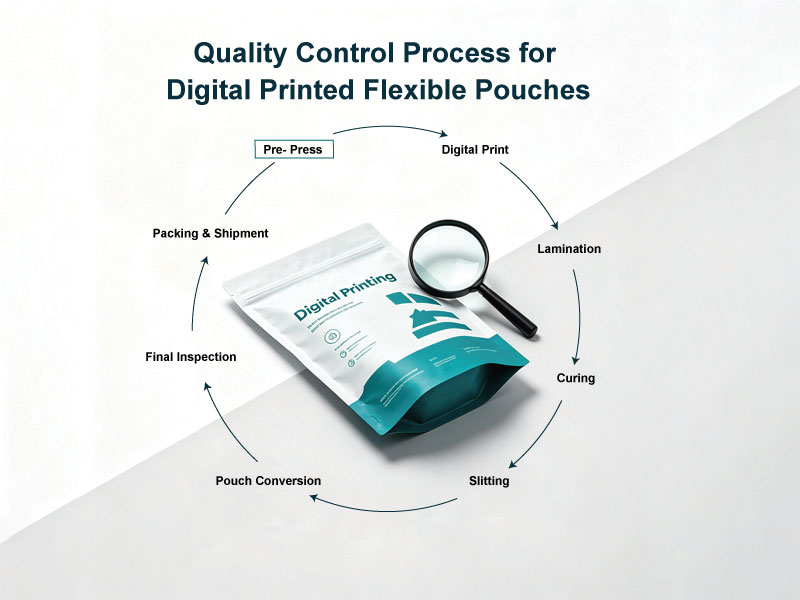
What Is Quality Control for Digital Printed Flexible Pouches?
The quality control of digital-printed flexible pouches involves continuous inspections of materials, printing, laminating, packaging-making and finished products to ensure that the final packaging meets the customers' requirements in terms of appearance, size, printing effect, color, composite strength, heat sealing performance, sealing ability, functional accessories and food-contact and regulatory requirements.
Why Quality Control Matters for Digital Printed Pouches
The inspections of various aspects such as quality, color, and material have the following effects on digital printed packaging:
- Prevent Print Defects
- Maintain Color Consistency
- Protect Package Performance
- Reduce Leakage, Rework, and Product Rejection
Digital Printed Pouch Quality Control Process at a Glance
Breaking down quality inspection into each production stage helps to detect problems as early as possible and avoids reworking only after the final product is completed. This ensures product quality and controls the production cycle.
|
Stage |
Quality Checks |
Common Issues |
|
Pre-Press & Artwork |
Size, dieline, text, barcode, color, SKU |
File errors, dieline mismatch |
|
Digital Printing |
Color, registration, clarity, coverage |
Color variation, banding, ink spots |
|
Lamination |
Structure, adhesive, bonding, appearance |
Bubbles, wrinkles, delamination |
|
Curing |
Time, conditions, bonding, odor |
Weak bonding, residual odor, blocking |
|
Slitting |
Width, edges, tension, alignment, splices |
Width deviation, uneven edges, telescoping |
|
Pouch Conversion |
Size, cutting, seals, zipper, valve, spout |
Size deviation, seal defects, misalignment |
|
Final Inspection |
Appearance, size, print, seals, function, SKU |
Print defects, seal defects, mixed SKUs |
|
Packing & Shipment |
Quantity, labels, cartons, packing |
Quantity errors, wrong labels, carton damage |
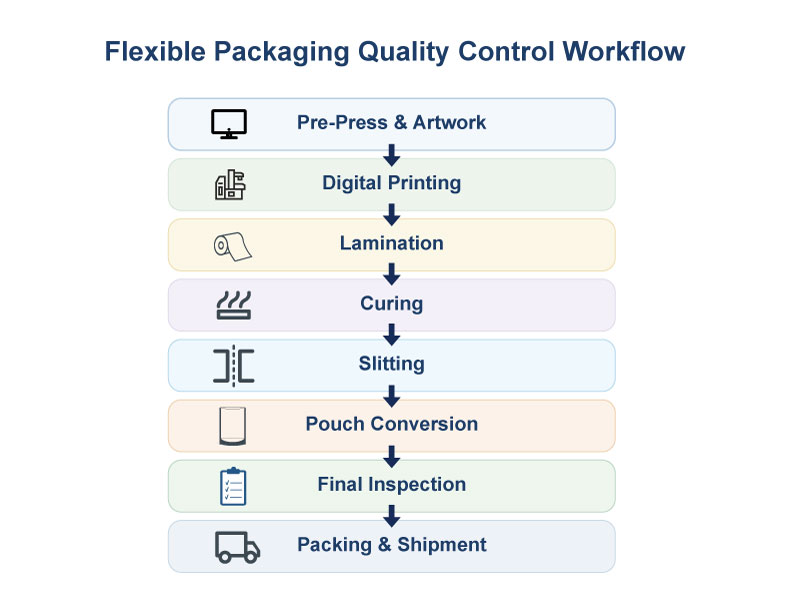
Pre-Press and Artwork Quality Control
Compared with ordinary flexible packaging, digital printing has another feature: the digital correspondence between the artwork and the final printing result is very important. Therefore, front-end file inspection is also part of the quality control.
Artwork and Dieline Verification
Indicate all process, materials, pouch type and processing effect on the design sketch. For example, spot UV or other special finishing effects should be compatible with the selected film and surface treatment.
Image Resolution and File Preparation
Check the clarity of the images and the file format to prevent printing blurriness and image distortion at the source.
Barcode, QR Code and Variable Data
Verify the readability of the codes and the accuracy of the variable content to prevent the production of finished products with invalid scanning or incorrect content.
Color Target and Proof Approval
Multi-SKU orders carry a significant risk of file mix-ups, therefore, it is necessary to confirm the color and sample. For instance, in a coffee series that includes Ethiopian coffee, Colombian coffee, and Brazilian coffee, if the wrong artistic design is used, it could result in errors in the entire batch of printing.
Digital Printing Quality Control
The focus of the digital printing stage is to ensure stable printing output to guarantee the consistency of the printed pouches and avoid visible defects.
Color Accuracy and Consistency
Compare the printed output with the approved color targets to reduce color variations.
Print Registration
Check the printing registration to ensure that graphics, text, and the white ink layer are precisely aligned.
Print Defect Inspection
Conduct random inspections for ink spots, stripes, and missing printing coverage, etc.
Ink Adhesion and Rub Resistance
Test the ink adhesion on the printed film. Poor ink adhesion can lead to scratches and ink shedding during handling, storage, or final product filling.
Lamination and Curing Quality Control
After printing is completed, the film undergoes laminating treatment to form a multi-layer structure. The quality control at this stage helps prevent defects that may occur during subsequent production or product usage.
Lamination Bond Strength
Weak bonds may cause delamination, thereby damaging the packaging integrity and rendering finished packaging unusable.
Adhesive and Coating Control
Uneven coating can lead to bubbles or wrinkles in the composite film, affecting its appearance and long-term stability.
Curing Verification
Insufficient curing will result in poor interlayer adhesion, residual odors, and film barrier phenomena during storage.
Barrier Performance When Required
For food, pet food, and other sensitive products, the barrier performance (for oxygen or moisture) of the finished composite film (regarding the finished product) should be verified according to the product technical specifications.
Slitting and Roll Quality Control
Slitting and roll directly impact the subsequent packaging manufacturing process.
Roll Width
The width must conform to the customized standards. Deviations may cause edge misalignment and failure to meet final product dimensions.
Slit Edge Quality
Rough, burr-prone, or cracked edges affect packaging appearance and increase risk of tearing during filling and use.
Winding Tension and Roll Condition
Maintain uniform, stable tension. Uneven tension causes loose or tight rolls, leading to wrinkles, tracking errors, and film damage in storage and transport.
Roll Direction and Core Requirements
Verify film winding direction and core diameter. Mismatched direction or core size prevents proper loading on automated packaging equipment, causing downtime or batch defects.
Pouch Conversion and Sealing Quality Control
The film sheet is processed by the packaging-making equipment to form the finished packaging. Inspection at this stage can prevent the occurrence of size errors and sealing defects.
Pouch Dimensions
Check the length, width and bottom size of the packaging. Dimensional errors may lead to poor product fit or wasted space.
Seal Strength
Test the heat sealing strength. Insufficient sealing strength will cause the seam to fail under filling pressure or during transportation.
Seal Integrity and Leak Resistance
Confirm the sealing integrity - avoid small gaps allowing air to enter, moisture to penetrate, and product leakage.
Functional Feature Inspection
Confirm that the zippers, discharge ports, and exhaust valves have been correctly installed-improper installation will affect their opening, re-sealing, or exhaust functions.
Final Inspection of Finished Digital Printed Pouches
Conduct a comprehensive visual and functional verification of the completed pouches.
Appearance Inspection
Check for printing defects, scratches, wrinkles, and surface contamination on the finished pouches to ensure the product appearance is intact.
Dimensional Inspection
Randomly measure the key dimensions of the packaging to confirm that the finished products meet the approved packaging specifications.
Functional Inspection
Test the sealing performance, accessory operation, and barrier performance requirements related to food-grade or high-demand applications.
Packing and Quantity Inspection
Verify the product quantity, outer box labels, and packaging conditions to avoid quantity errors or label mismatches before shipment.
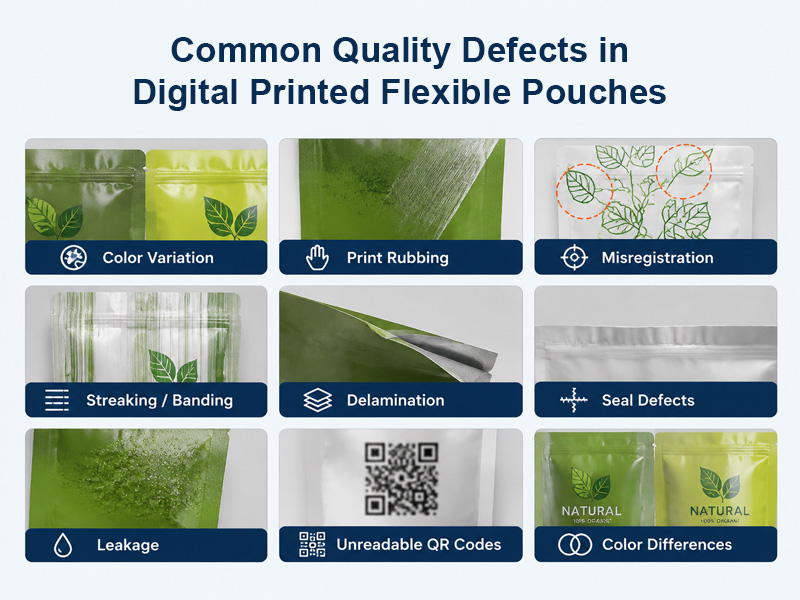
Common Quality Problems in Digital Printed Flexible Pouches
Digital printed flexible pouches may encounter the following typical quality problems during production:
- Color Variation
- Print Rubbing
- Misregistration
- Streaking or Banding
- Delamination
- Seal Defects
- Leakage
- Unreadable QR Codes
- Repeat-Order Color Differences
What Should Brands Check Before Approving Digital Printed Pouches?
Brand-side inspection is essential to avoid batch errors.
Before Production: Make sure the final artwork is confirmed. Check that approved color standards are clear. Confirm the material structure and all functional needs are met. This pre-production step locks, in the details and helps stop any wrong direction during mass production.
Before Shipment: Inspect the pouch for appearance color match, sealing strength, correct batch quantity and accurate packaging labels. This ensures every shipment is stable, consistent and meets quality requirements.
How to Maintain Consistent Quality for Repeat Orders
Standardized management ensures stable quality.
Approved Color Reference
Use approved color samples as unified standards to avoid color deviation.
Material and Structure Consistency
Keep consistent raw materials and structural settings without arbitrary changes.
Production Records
Record full production parameters to maintain traceable repeat-order standards.
Repeat-Order Comparison
Compare new batches with qualified old samples to spot subtle quality differences.
Retain Samples and QC Records
Preserve samples and complete QC records for stable quality reference.
When Should Brands Request Additional Packaging Tests?
Standard routine QC meets general packaging requirements. For high-risk packaging applications, targeted additional tests are necessary to ensure product safety, sealing reliability and long-term shelf stability.
|
Packaging Type |
Key Additional Tests |
|
Oxygen barrier, one-way valve performance |
|
|
Moisture and grease barrier, seal integrity |
|
|
Retort Packaging |
High-temperature resistance, lamination bonding |
|
Easy-Open Packaging |
Tear resistance, balanced seal strength |
FAQ
Can quality inspection fully eliminate all pouch defects?
Not completely. With strict multi-stage quality control small individual defects can still happen during mass production. Suppliers follow industry standards. Set acceptable defect rates. Sampling inspections help make sure the overall product quality stays within the agreed limits.
How can brands verify a supplier’s real-world QC capability before placing orders?
Brands can ask for sample evaluations review the supplier’s quality-control documents or request reference cases of similar products they have produced. Pre-production trial runs are also a way to test how well the supplier performs in actual quality control.
What should I do if I find quality defects after receiving bulk-order pouches?
Send the samples, photos and batch details to the supplier. Reputable packaging manufacturers will look into the issue by checking production records and quality inspection logs. They will then identify the root cause. Offer practical solutions—such, as replacing the faulty items or adjusting future orders.
Conclusion
The package requires quality control before it is sent out for shipping. Knowing the control points can help lower the number of flaws during the whole time the product is on the shelf.
Do you want to talk about the quality standards for your printed packaging? Contact us for more information.