
When many brands customize packaging, they often find it difficult to select material. Choosing the right material requires considering both the practical performance and appearance effect, which is challenging for professionals.
Food, health supplement, snack, and daily-use brands prefer digital printing packaging, but not all packaging films are suitable for this process. Improper material selection can lead to color fading, ink peeling, pattern distortion, and even reduce the protective ability of the packaging and shorten the product's shelf life.
To create packaging with outstanding appearance, reliable protection,and in line with environmental requirements, it is necessary to select special substrates suitable for digital printing.
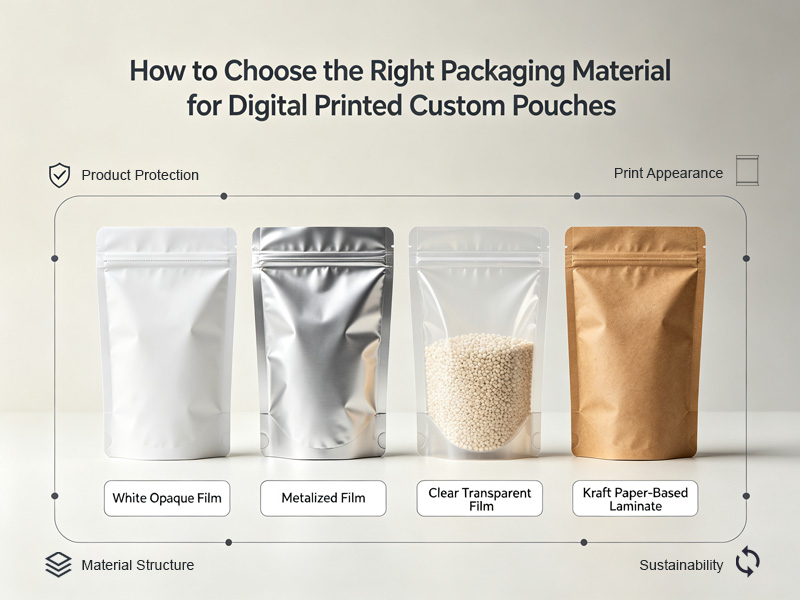
Assess Your Product Protection Requirements
Moisture & Oxygen Barrier
Coffee, snacks and powdered foods may require stronger barrier performance. These products with lower moisture or oxygen sensitivity need a standard barrier structure.
Light & Ultraviolet(UV) Protection
Light can affect the quality and shelf life of products. Transparent packaging offers limited protection against light, while opaque or metallized structures can provide better protection.
Special Product Requirements
We need to consider the pain points of packaging for different products.
- Sharp contents: Nuts and dried fruits with sharp edges require a tougher puncture-resistant layer. Nylon (PA) often used for them.
- Oily products: Fried snacks and cured meat products need oil-resistant materials to prevent the oil from seeping out.
- Liquid products: Thick-structure material with reliable sealing performance is suitable for liquid condiments.
- Roasted coffee: A one-way degassing valve is a common feature for roasted coffee packaging. It can help release gas.
Choosing the Printing Substrate Based on Appearance
Determine your required substrate. Ask yourself: What kind of visual effect do I want?
White Opaque Film
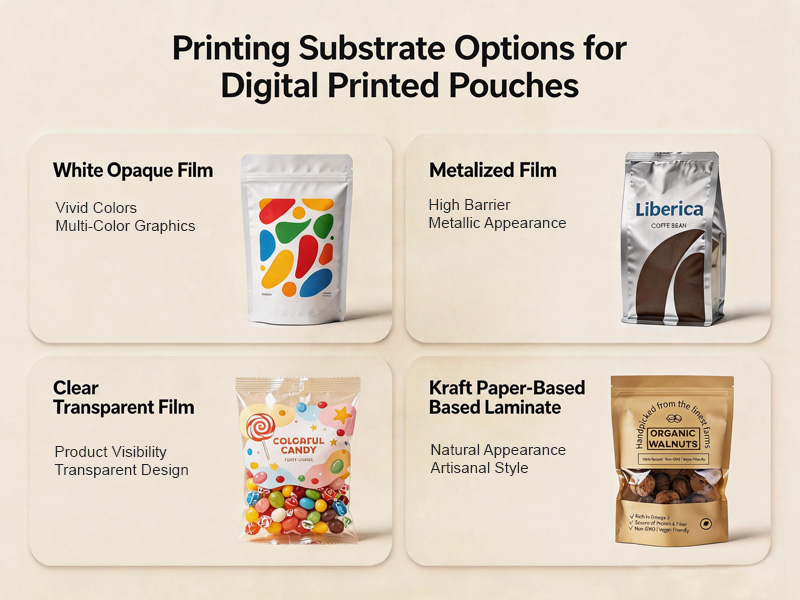
If your design featuring vivid colors, the white opaque film is helpful. It is a nice option in digital printing.
Metalized Film
Metalized film provides a premium metallic appearance. For digital printing, the metallic base will darken standard inks. So a white ink underlayer may be used to improve color brightness.
Clear Transparent Film
Transparent film makes the product visible. Candies and other products are often packaged in clear film.
Kraft Paper-Based Laminates
We often see products that strive for handcrafted quality being packaged in kraft paper. The simple packaging design might be more favored by customers. Please note that Kraft packaging are not always recyclable.
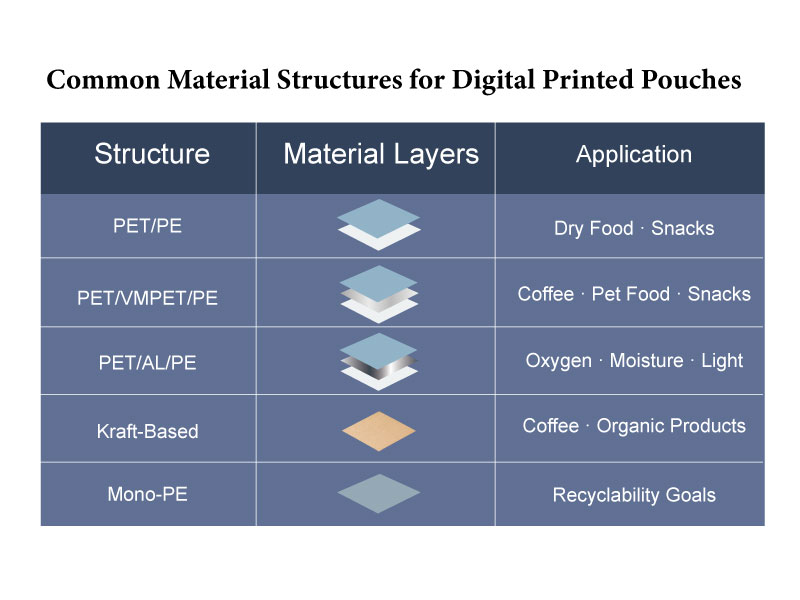
Common Material Structures for Digital Printed Pouches
After defining the desired appearance, select the material structure based on product protection, pouch performance and other functional requirements.
|
Material Structure |
Best For |
Advantages |
|
PET/PE |
Dry food, snacks, general consumer products |
Good print surface; good mechanical strength; good sealing performance; |
|
PET/VMPET/PE |
Coffee, snacks, pet food, products requiring stronger barrier |
Oxygen and moisture barrier; light protection; metallic appearance |
|
PET/AL/PE |
High-barrier applications |
Strong oxygen, moisture and light barrier |
|
Kraft |
Organic/natural products like coffee |
Natural appearance; premium visual appeal; strong brand positioning |
|
Mono-PE |
Brands with mono-material or recyclability goals |
supports recyclability strategies; simplified material composition |
Other Factors That Affect Material Selection
Sustainability
Driven by cost concerns and packaging compliance rules, PCR recycled and mono-material recyclable materials are growing in demand. Brands need to balance their sustainable development goals with compliance requirements and budgets.
Pouch Style
In practical applications, not all films are suitable for all packaging types. Choose a material structure that suit the intended pouch format. We offer customized services in various bag types. Such as stand up pouches, flat pouches, or spout pouches.
Cost
Digital printing supports small batch orders and there are significant cost differences for different materials. High barrier aluminum-coated films and special environmentally friendly materials will increase the unit price of packaging.
Supplier Testing
Ask suppliers for material WVTR and OTR data and arrange sampling. Test print color, seal strength and real-product storage performance before mass production.
How to Choose the Right Material Step by Step
Choose suitable material for packaging need thinking and here are simplified steps to refer:
Step 1: Identify Your Product
The easiest way to start material selection is to work backward from the product.
Start by defining what will be packed.
Ask:
- What is the product?
- Is it dry, oily or moisture-sensitive?
- Does it contain strong aromas?
- How long does it need to remain fresh?
The answers determine the basic protection requirements.
Step 2: Define Barrier Requirements
Determine which barriers are important.
you may need:
- Moisture barrier
- Oxygen barrier
- Light barrier
- Aroma barrier
The goal is to meet the required performance without unnecessarily over-engineering the structure.
Step 3: Choose Your Pouch Format
Determine the bag type based on product quality and other requirements:
The material structure needs to support the physical construction of the finished pouch.
Step 4: Define Your Print Appearance
Determine the printing appearance based on the packaging promotion requirements, etc.:
- Matte
- Glossy
- Transparent
- Metallic
- Kraft
- High-resolution graphics
- White ink
Step 5: Check Printing & Converting Compatibility
Confirm that the structure is suitable for:
Digital Printing → Lamination → Curing → Sealing → Pouch Making
This helps reduce problems later in production.
Step 6: Consider Compliance & Sustainability
Consider:
- Target marke
- Food-contact requirements
- Sustainability needs
Step 7: Balance Performance and Cost
The final step is to balance the requirements.
ask: What is the simplest material structure that can provide the required product protection, printing quality and pouch performance?
Instead of asking: What is the cheapest material?
This approach can help avoid both under-specification and unnecessary material complexity.
FAQ About Pouch Packaging Materials
1. Does Pouch Material Affect Digital Print Quality?
Yes. Substrate color, surface characteristics and opacity can affect color reproduction and the overall appearance of digitally printed graphics. White ink can be used to increase the opacity and color brightness on specific substrates.
2. What Is the Best Material for Digital Printed Pouches?
No single packaging material is suitable for all products. The best choice depends on the characteristics of the product and the brand's requirements: metallized films are suitable for products that require high barrier properties and preservation capabilities; transparent films are suitable for brands that need to enhance the visibility of their products.
3. How to choose pouch packaging material for snacks?
Selecting snack packaging depends on oil resistance, oxygen barrier, and light barrier properties. Transparent films are suitable for product display, high barrier metallized films can effectively extend the shelf life, and coated kraft paper is suitable for snacks with an organic style positioning.
Final Checklist for Choosing Your Pouch Material
1. List your product requirements:moisture, oxygen, light, oil, sharp content
2. Confirm your digital printing design:vibrant colors? metallic look? need to show product?
3. Shortlist 2-3 candidate materials from comparison table
4. Evaluate sustainability goals and real-world material performance
5. Request sample prints and barrier data from your supplier
6. Test the packaging with your actual product
Conclusion
The printing effect of digital-printed packaging is as important as product protection; do not just focus on the appearance. Combine barrier performance, digital printing compatibility, and sustainability goals, and choose the most suitable material.
If you are unsure, please send us your product type and design requirements. We will help you make an assessment.