
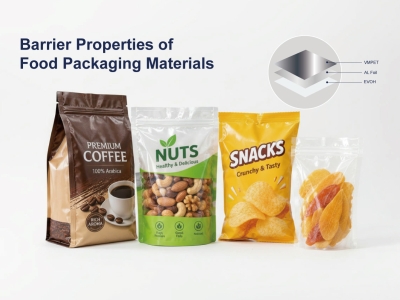
Choosing the wrong packaging material can shorten food shelf life. Oxygen, moisture, light and external odors may affect food quality during storage and transportation. But which material offers the right protection for your product?
1. What Are Barrier Properties in Food Packaging?
Barrier properties refer to blocking oxygen, moisture, light and odor. This protects product integrity and extends shelf life.
Food products require barrier protection for freshness reservation. The meat is packed into high-barrier bags. During transportation, it keeps other things out. After a long journey, the food is safely delivered to the market. Finally, it is sold and served on the table.
Selecting suitable barrier-property materials bases on your product. It will affect the shelf life and overall product quality.
2. Key Barrier Properties for Food Packaging
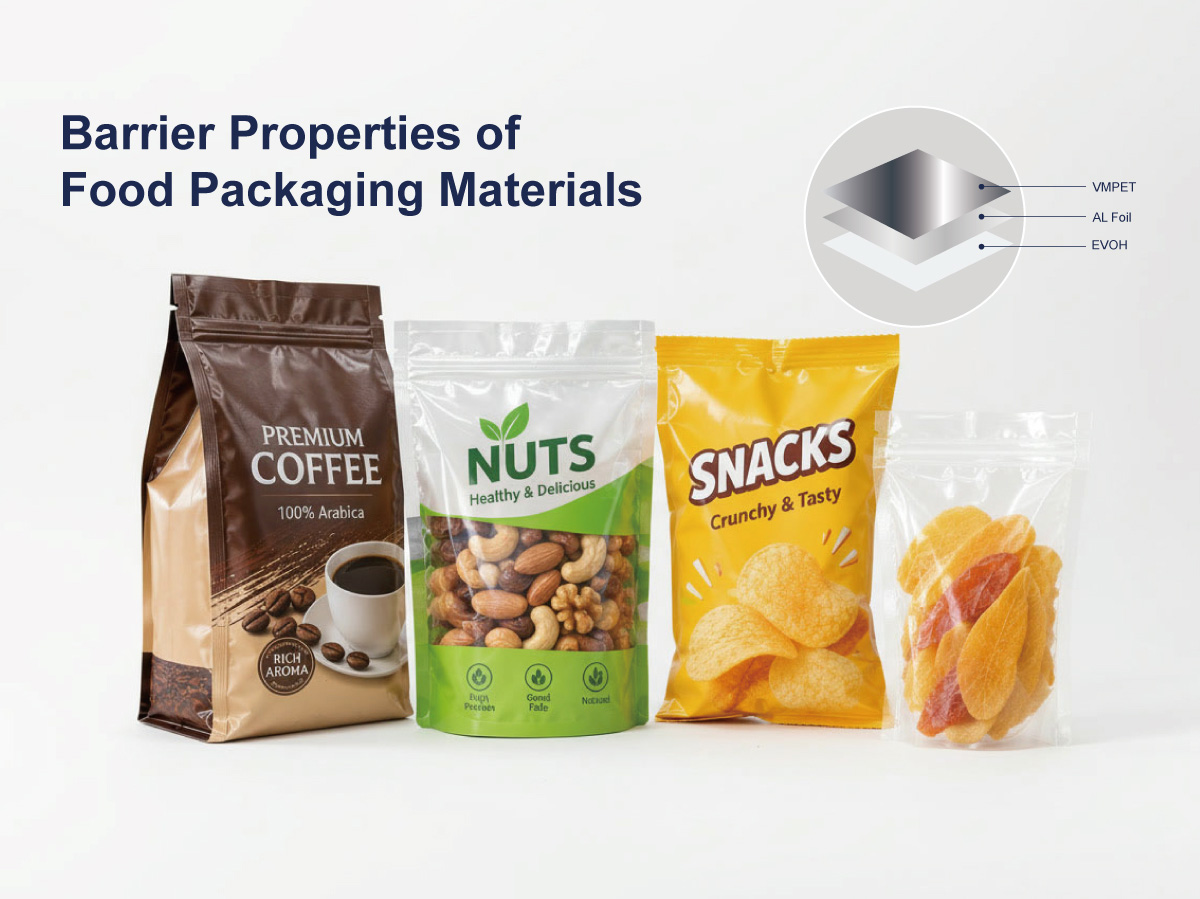
Oxygen Barrier (OTR)
Oxygen barrier is measured by oxygen transmission rate (OTR).
Food exposed to oxygen will oxidize. It will cause changes in flavor.
High oxygen barrier films work well to keep oxygen out. They are suitable for sensitive foods. Coffee, nuts and meat always need high oxygen barrier packaging.
Moisture Barrier (WVTR)
Moisture barrier performance gets measured by Water Vapor Transmission Rate(WVTR).
You might have had such an experience: You open a bag of potato chips, eat half of it, and leave it open for a while. Then it gets damp and becomes soft. Good moisture barrier packaging fits potato chips, biscuits and dried fruits.
Light Barrier
Light can harm certain foods during storage. It fades product colour, weaken flavour and break down nutrients. Light barrier packaging blocks these rays. It reduces light-sensitive foods’ quality loss. Common foods that rely on this protection include chocolate, edible oil and tea leaves.
Aroma Barrier
Aroma barrier serves two purposes. It locks food’s natural flavour inside packaging. It also keeps unwanted external odours out. Typical products: coffee, tea leaves and spices.
Microbial Barrier
This barrier is less often discussed for flexible food packaging. Microbial barrier keeps bacteria, mould out of packages. It slows food spoilage. It depends on intact seals and puncture resistance. High-risk foods use this packaging.
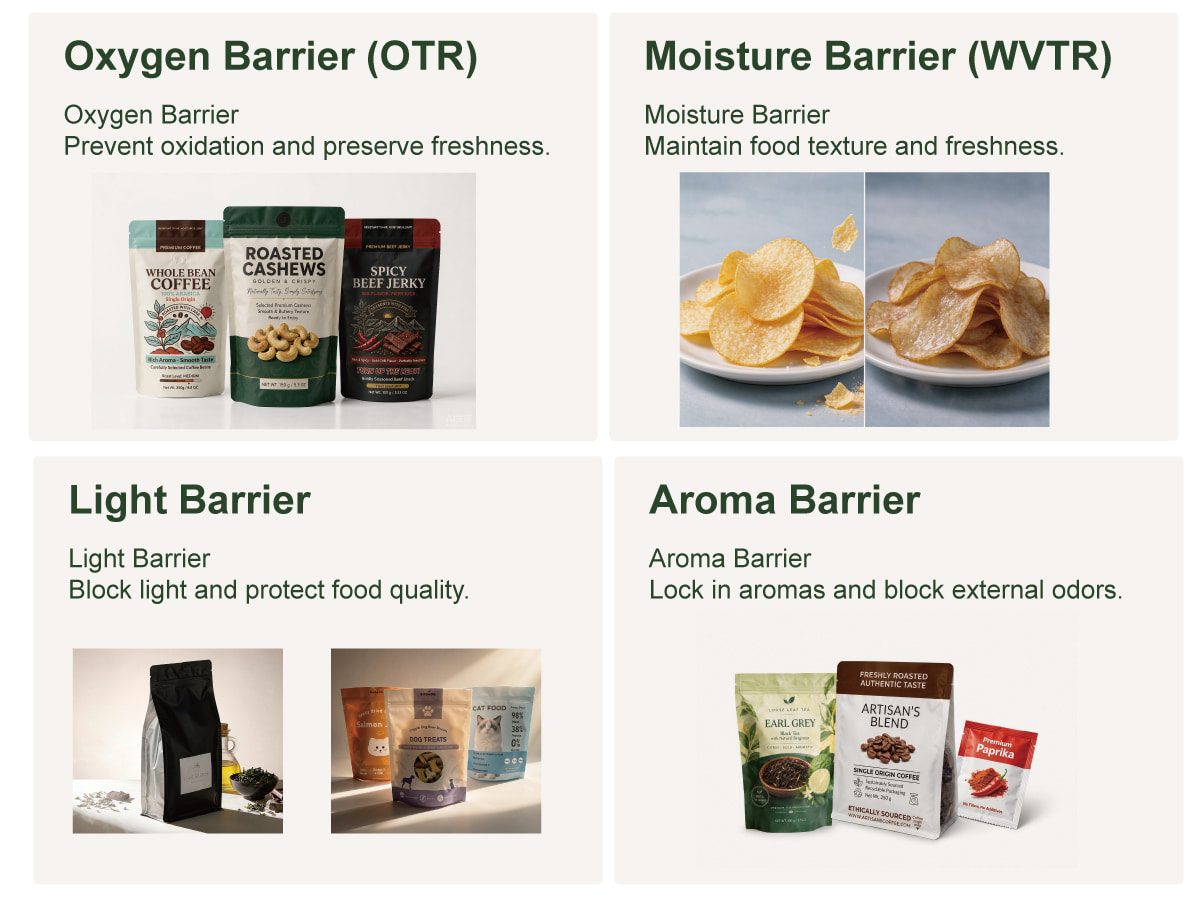
3. Comparing AL Foil, VMPET, and EVOH
For barrier protection, AL foil, VMPET and EVOH are common choices for flexible packaging customers.
|
Comparison |
AL Foil |
VMPET |
EVOH |
|
Material Type |
Aluminum foil |
Metallized PET film |
Barrier polymer |
|
Oxygen Barrier |
Excellent |
Good to high, structure-dependent |
Excellent under suitable humidity conditions |
|
Moisture Barrier |
Excellent |
Good, structure-dependent |
Requires moisture-protective layers |
|
Light Barrier |
Opaque |
Generally strong, depending on metallization |
Transparent |
|
Humidity Sensitivity |
Low |
Depends on the full structure |
High |
|
Typical Use |
High-barrier foil laminates |
Metallized flexible packaging |
Multilayer laminated films |
There is not exact ranking for every material. For instance, VMPET’s barrier performance depends on several elements. Film thickness, lamination process and operating conditions also matter.
3.1 Aluminum Foil (AL Foil)
Aluminium(AL) delivers strong oxygen, moisture, light and aroma barrier performance. Coffee, pet food and other shelf-life sensitive foods commonly use this material. A typical composite structure is PET/AL/PE.
Choose AL for your products package structure need to consider some factors: cost, crease damage and others.
For example, if Aluminum foil bends, it will form permanent creases. Sharp creases are prone to tearing the aluminum layer. It will directly compromise the oxygen, moisture, and light-blocking properties.
3.2 Metallized PET (VMPET)
VMPET: A very thin metal layer is formed on the surface of the PET membrane through vacuum aluminization.
It has good oxygen & moisture barrier, but not absolute. It partially blocks light, not 100% opaque.
Bending or scratching may crack aluminum coating, barrier drops sharply.
3.3 EVOH (Ethylene Vinyl Alcohol)
EVOH is a transparent high-barrier resin. It is not a metal foil or an aluminum-coated film.
It demonstrates excellent barrier properties under dry conditions. In high humidity, its barrier performance drops. Oxygen passes through more easily. This spoils the freshness of food.
That is why EVOH must pair with other material layers.
Multi-layer films with EVOH suit oxygen-sensitive foods. Meat and dairy products commonly use this structure.
→Request a Flexible Packaging Solution
4. How Do Packaging Structures Affect Barrier Performance?
Custom barrier-property packaging can retain products freshness effectively.
4.1 Single-Layer vs. Multilayer Packaging
Single-layer films use just one polymer type. You can custom mono-material packs. They help with recycling or lower your costs. But watch out: these films may offer weak barrier performance.
For some products needing special barrier, multi-layer packaging may be the better choice.
Inner, middle and outer layers each have jobs. The inner layer supports clear printing. The middle layer gives the mechanical strength. Other layers act as barriers.
Brands come to us for custom structures. These designs fit their product requirements. Vacuum meat pouches and coffee bags use this setup.
4.2 Common Flexible Packaging Structures
|
Structure |
Main Function |
Suitable For |
|
PET/AL/PE |
High-barrier, light-block and heat seal |
Long-term shelf-life foods; milk powder, coffee, sensitive sauces. |
|
PET/VMPET/PE |
VM barrier, print and heat seal |
Medium shelf life foods; potato chips, tea, regular coffee, dry goods, limited budget |
|
PET/PE/EVOH/PE |
Transparent, oxygen-barrier |
Need to show, antioxidant-protected; fresh meat, dairy products, and chilled fresh foods |
|
PA/EVOH/PE |
Strong mechanical performance, oxygen barrier |
Bone-in meat, hard pieces, heavy fills. |
4.3 Factors That Influence Barrier Performance
Many factors affect real-world barrier performance.
- Material thickness: For example, thin VMPET allows more oxygen to pass through.
- Layer composition: Stack different film layers. Protection levels shift.
- Metallization quality: Uneven coating of aluminium drags barrier performance down.
- Pinholes and flex cracking: Bending the pouch generates tiny pinholes and cracks. These defects break the barrier.
- Sealing and package integrity: Poor sealing creates leaks.
Other conditions like lamination quality also impact the final barrier result.
5. Choose the Right Barrier Material for Your Food Product
The suitable packaging structure relies on several key factors:
- Product characteristics
- Required shelf life
- Filling process
- Storage environment
- Transportation conditions
- Brand positioning
Unsure which barrier material to pick? You can make your choice by referring to examples from the food industry.
|
Food Product |
Main Packaging Concerns |
Material Direction |
|
Coffee |
Oxygen, moisture, aroma and light |
AL Foil or VMPET laminates |
|
Nuts and Seeds |
Oxygen, moisture and rancidity |
High-barrier laminates |
|
Moisture and oxygen |
VMPET-based or other suitable barrier structures |
|
|
Oxygen, moisture, aroma and mechanical protection |
AL Foil, VMPET or suitable multilayer structures |
|
|
Meat and Seafood |
Oxygen, moisture and package integrity |
EVOH-containing or other suitable high-barrier structures |
What function do you want the package to achieve?
FAQs About Food Packaging Barrier Properties
1. Are barrier materials safe for food?
Yes. You can pick food-grade barrier materials. Ask your supplier for compliance paperwork. If you check meat packaging, you will find these certificates prove harmful substances won’t move into food.
2. Is VMPET as effective as aluminum foil?
It cannot reach aluminium foil’s high barrier level. Even so, we often use VMPET for many mid-barrier jobs. In our cooperation, it is widely used for tea.
3. Can barriers and sustainability both be achieved?
Sure. When you make this selection, trade-offs are needed. You balance shelf-life demands and recyclability goals. Different foods mean you need custom material solutions.
4. Do coffee bags always need aluminum foil?
Not necessarily. Coffee packaging can use VMPET, EVOH or other viable structures. Additionally, you can customize valves for coffee packs.
CONCLUSION
High-barrier packaging helps protect food quality during long-distance transportation. It keeps food fresh and intact from production to the consumer's table.
Whether you need small-batch packaging for product testing or larger runs for regular production, we can customize barrier film to match your product requirements.
Share your product details with us, and let's find the right barrier solution for your needs.

